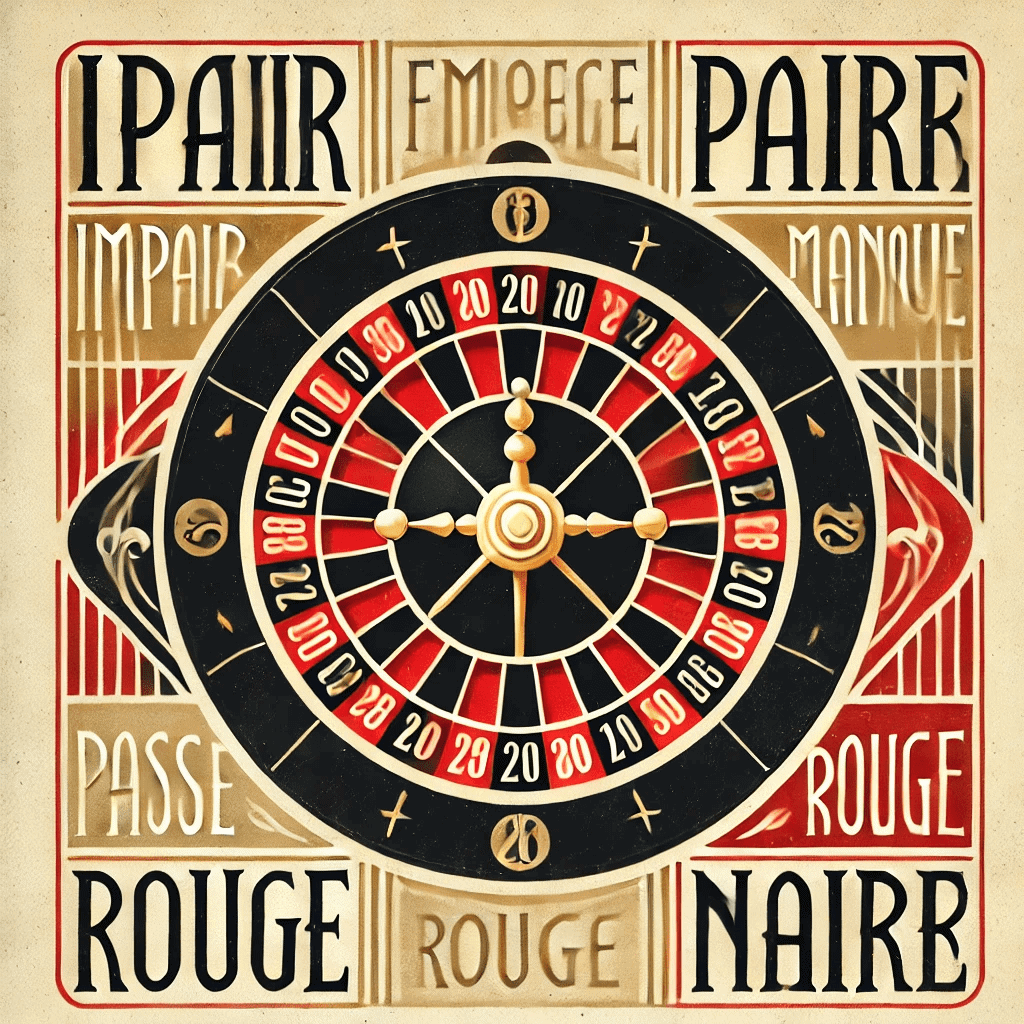
French roulette is a gambling game where you have to place a bet and guess which pocket the ball will land in on the spinning wheel. Although it is believed to be the first game of its kind, it still has much in common with each of the variants.

French original terms are used in the traditional game. Below is the game board where bets are placed.
Bets on French roulette
French roulette bets are almost identical to traditional ones; the only thing that distinguishes them is that they are called and written in the original language.
In French roulette, the inside bets are as follows: En plein — straight bet; Cheval — split; Transversale — street; Carré — corner; Sixainne — line.
Differences between European and French roulette
The main difference between French and European roulette is the RTP, which stands for the theoretical return to player percentage. In Europe, this figure is 97.3%, while in France it is 98.75%. The French version has the highest chances of winning!
This is achieved by including additional rules that provide players with advantages.
Rules of French roulette En Prison and La Partage
“If a zero comes up on the roulette wheel, half of the bet made on even chances is returned,” states the La Partage rule. This means that when zero comes up, you lose only half the bet, not the entire bet.
The En Prison rule behaves differently. The dealer marks all even-money bets when a zero comes up. Thus, he “puts the bets in jail,” forcing players to repeat them on the next spin. The player gets their initial bet back if the bet wins.
If the even-money bet doesn’t win, it’s a second, free attempt. However, it’s important to remember that this is not a mandatory rule, but rather an additional rule that may be found in some casinos.
In a casino, French roulette is a game where success depends on fortune. Although it is slight, the operator always has the advantage. You can make money in it, but it’s impossible to stay in the black over the long run.
Many users employ strategies. Although they do not guarantee big wins, they increase the chances of success. The most common tactics are Martingale, D’Alembert, Labouchere, etc. Their use requires a large capital. Moreover, most schemes are intended only for even-money bets.
Each outcome has a chance of occurring. Professional players often use this data. They collect and analyze statistics to determine the most common numbers. While this increases the likelihood of a successful outcome, it does not guarantee profit. Roulette should be viewed as entertainment, not as a source of income.